Other Commonly Available Low-Energy Vegetables
Information on tomatoes, peppers, radishes, mushrooms, and additional produce items displaying low energy density in their fresh, uncooked forms.
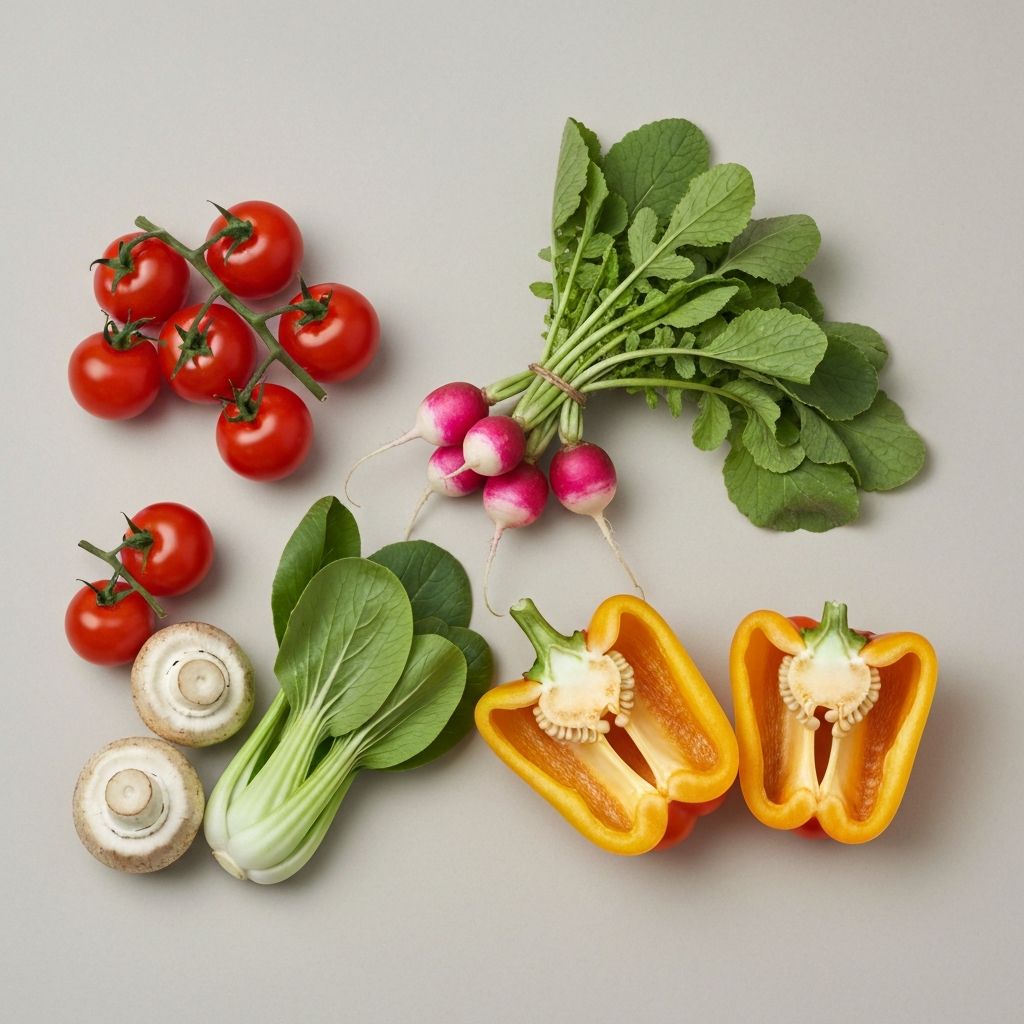
Diverse Low-Density Produce Beyond Primary Categories
Beyond leafy greens, cruciferous vegetables, and the highest-water vegetables, numerous additional produce items display low energy density characteristics. These vegetables, though not fitting neatly into single categories, share compositional features that result in low caloric density despite varying structure and botanical origin.
Tomato Characteristics
Tomatoes are botanically fruits (specifically berries) though culinarily classified as vegetables. Raw tomatoes contain approximately 95% water and approximately 18 kcal per 100 grams. The fruit structure comprises exterior skin, juicy interior flesh, and central seed cavities surrounded by gelatinous material. The cellular composition is predominantly water with minimal solids. Tomato variety affects water content slightly, with more watery varieties like cherry tomatoes reaching 94–95% water content.
Bell Pepper Structure
Bell peppers are also botanically fruits and contain approximately 92% water with approximately 31 kcal per 100 grams. The hollow interior cavity is surrounded by thick-walled flesh composed primarily of water. Pepper color (green, red, yellow, orange) represents different ripeness stages, with minimal compositional differences between varieties. The relatively higher energy density compared to cucumber or celery reflects slightly lower water content and higher carbohydrate concentration.
Radish Characteristics
Radishes are root vegetables that store carbohydrates and water in swollen root structures. Despite root vegetable classification, radishes maintain very high water content at approximately 95% and energy density of approximately 16 kcal per 100 grams. The crisp texture derives from cellular turgor pressure similar to cucumber. Raw radishes contain substantial fibre relative to their small size.
Mushroom Classification
Mushrooms are not vegetables botanically but are commonly classified culinarily with vegetables. Button mushrooms, the most common variety, contain approximately 92% water and approximately 22 kcal per 100 grams. The cellular structure differs substantially from plant vegetables, being composed of fungal hyphae rather than plant cells. Despite structural differences, mushrooms achieve low energy density through high water content and minimal solids.
Asparagus Structure
Asparagus consists of tender spear stems harvested at early growth stages. Mature asparagus has a stronger, more fibrous texture. Raw asparagus contains approximately 93% water and approximately 20 kcal per 100 grams. The elongated structure and fibrous arrangement resemble celery in some respects, though botanical origin and development patterns differ substantially.
| Vegetable | Water % | kcal/100g | Fibre g/100g | Botanical Type |
|---|---|---|---|---|
| Tomato | 95% | 18 | 1.2 | Berry (fruit) |
| Bell Pepper | 92% | 31 | 1.9 | Berry (fruit) |
| Radish | 95% | 16 | 0.7 | Root vegetable |
| Mushroom | 92% | 22 | 0.7 | Fungus |
| Asparagus | 93% | 20 | 2.1 | Stem vegetable |
Pak Choi and Other Asian Varieties
Pak choi (also called bok choy) represents Asian leafy vegetable varieties with similar compositional characteristics to Western leafy greens. Raw pak choi contains approximately 95% water and approximately 13 kcal per 100 grams, among the lowest energy density values. Other Asian vegetables like gai lan (Chinese broccoli) display comparable low energy density profiles despite different cultural origins and culinary applications.
Return to Main Resources
Explore comprehensive information about vegetables with low energy density.
Back to homepage