Water Content Across Vegetable Families
Comparative overview of hydration levels across different vegetable categories and how water percentages influence energy density values.
Understanding Water as a Major Component
Water represents the dominant component of most vegetables, typically comprising 80–96% of total weight. This high water content directly influences energy density because water contains zero calories. The percentage of water in a vegetable determines how much of the remaining weight consists of calorie-bearing compounds like carbohydrates, proteins, and fats.
Water Content Ranges Across Categories
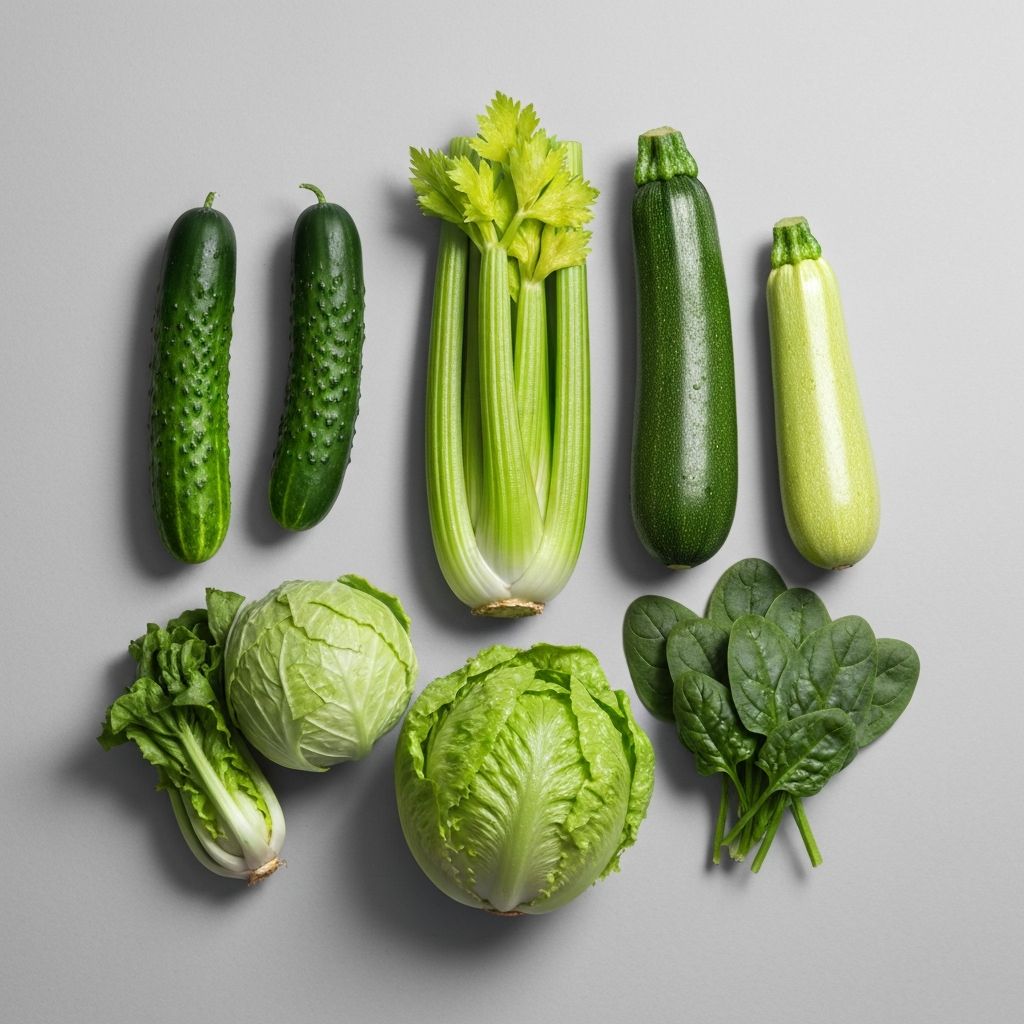
Different vegetable families exhibit distinct water content patterns. Leafy greens and cruciferous vegetables show particularly high water percentages, ranging from 84–96%. High-water vegetables like cucumber, celery, and courgette approach 95–96% water content. Root vegetables and other categories display slightly lower but still substantial hydration levels.
| Category | Typical Water % | Example Vegetables |
|---|---|---|
| Leafy Greens | 84–96% | Spinach, lettuce, kale, chard |
| Cruciferous | 89–92% | Broccoli, cauliflower, cabbage |
| High-Water | 95–96% | Cucumber, celery, courgette |
| Other Vegetables | 92–95% | Tomato, pepper, radish, mushroom |
The Relationship Between Water Content and Energy Density
A direct inverse relationship exists between water percentage and energy density. Vegetables with 96% water content, such as lettuce and cucumber, contain approximately 15–16 kcal per 100 grams. By contrast, vegetables with 84% water content, such as kale, contain approximately 49 kcal per 100 grams. The 12 percentage-point difference in water content corresponds to a threefold difference in energy density.
Biological Significance of High Water Content
Water serves essential biological functions in living vegetables. It maintains cellular turgor pressure, providing structural rigidity to plant cells. Water also enables nutrient transport and participates in metabolic processes. This biological necessity explains why vegetables maintain such high hydration levels even after harvest—the water remains bound within cell structures.
Explore Related Topics
Learn more about the factors influencing energy density in vegetables.
View next article